
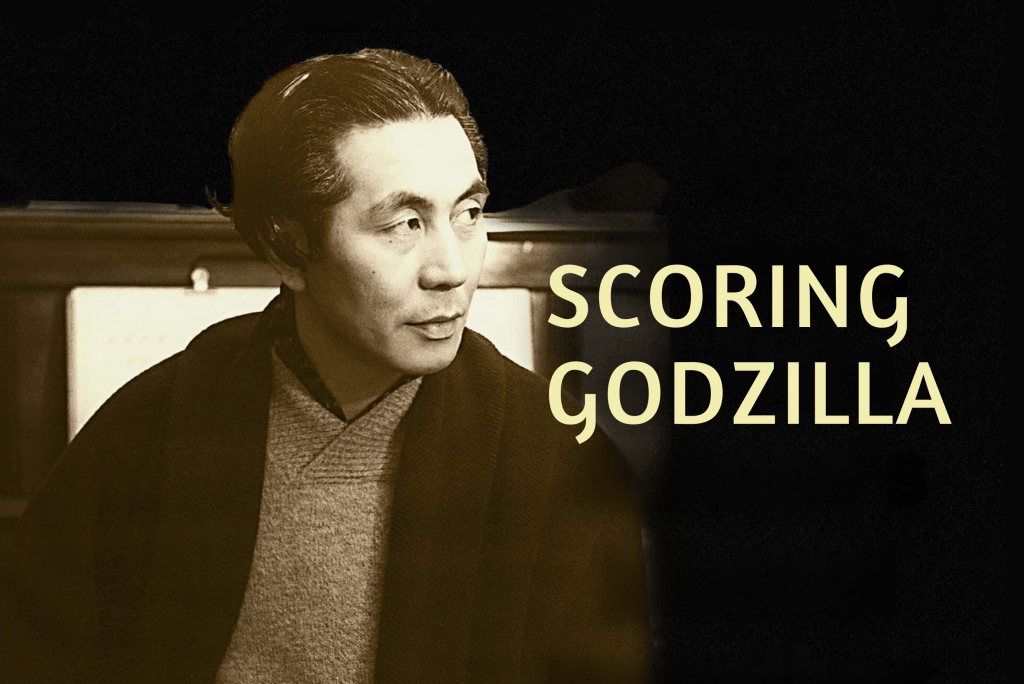
For two decades, author Erik Homenick has been deeply immersed in the life and work of composer Akira Ifukube. Erik grew up a Godzilla fan and loving Ifukube’s iconic music for those films, but losing the composer in 2006 really sparked a desire in him to understand the full scope of Ifukube’s career. That led Erik to found AKIRAIFUKUBE.ORG, an online museum and research center dedicated to the composer’s art and legacy.

When he started his PhD in Literature at UC San Diego in 2017, he’d originally planned to focus on French literature, but his doctoral advisor, Japanese film scholar Daisuke Miyao, steered him toward Japanese cinema, and Ifukube’s music became central to his work.
His dissertation eventually grew into the upcoming book “Scoring Godzilla: An Analysis of Akira Ifukube’s Musical Narratives” now available for pre-order from McFarland and Company.
As a lifelong Godzilla fan, I stumbled across a mention of Scoring Godzilla while searching for an English-language book on Akira Ifukube. One thing led to another and I reached out to Erik to learn more, which turned into asking for an interview, which Erik was kind enough to say yes to. Hope you enjoy it!
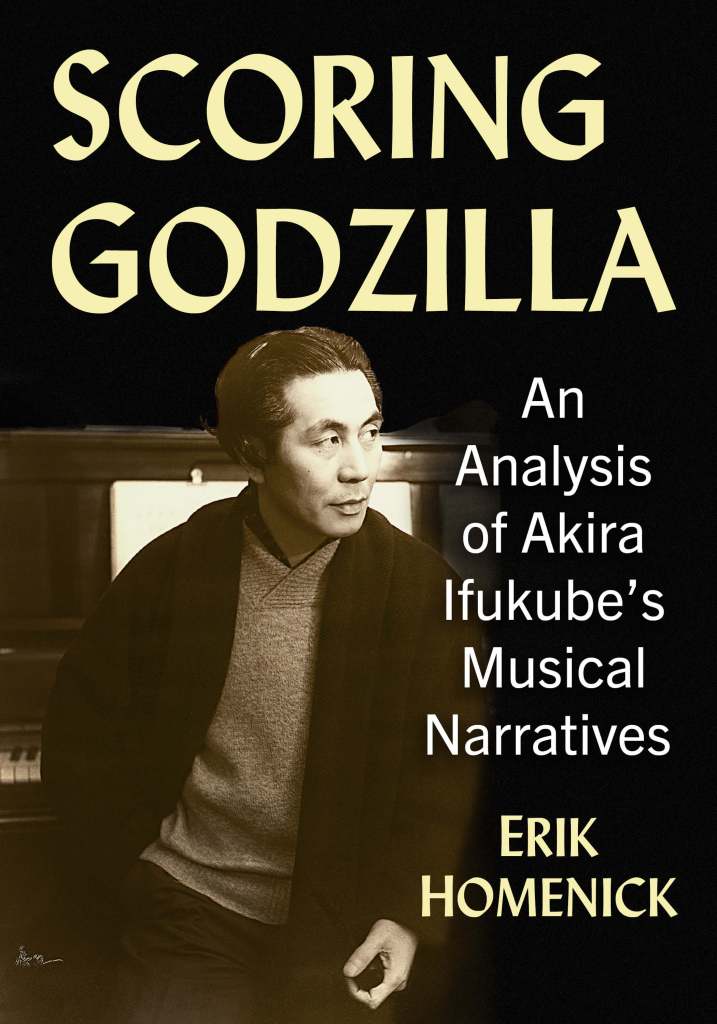
How would you describe your new book “Scoring Godzilla: An Analysis of Akira Ifukube’s Musical Narratives?
The book is an attempt to foreground film music as an important point of departure for wider film analysis. It asks the question “what if we raise a film’s music to the level of narrative importance of, say, the screenplay?” What I mean by this is that film music is often thought of as mere “background sound” by commentators and critics—it is often considered to be of secondary or tertiary importance when compared to, for example, the screenplay, the actors’ performances, and/or the artistic vision of the director.
Scoring Godzilla proposes that a film’s composer must be considered a legitimate auteur filmmaker who has the same capacity to imprint his or her worldview and artistic vision into the cinematic productions that he or she scores. Akira Ifukube was a composer with a very distinctive worldview and a singular artistic vision. As a “nationalist” and “antimodern” composer, he sought to express a proud sense of “Japaneseness” in his concert compositions, and, certainly, his film music uses a lot of the same techniques as his concert scores. Therefore, I assert that his Godzilla scores are imbued with the very sort of nationalist and anti-modern expression that is representative of his general style.
Ultimately, my book proposes that Ifukube employs a variety of definable techniques and modes of expression in his Godzilla scores that articulate, through music, statements of the composer’s distinctive philosophies. If music can be a form of filmic narration, we can therefore arrive at novel interpretations of these films informed by how Ifukube’s musical nationalism expresses itself in these soundtracks. “How can we extract new levels of meaning from these films when we treat their scores as a true narrative text, not just background music?” This is what my book is asking.
What the book argues, then, is that Ifukube’s work in Godzilla films functions as more than just superficial “monster music.” There’s something much more deep and subtle at play. I assert the composer is using his music to frame monsters like Godzilla as representative of an ancient Japanese national ethos, the very type of ethos that he seeks to express in all of his musical works. This definitely complicates how we might interpret Godzilla films when we have this idea in mind.
I should add also that, although the book is not a comprehensive biography of the composer per se, it includes copious amounts of biographical elements, and readers will enjoy, I hope, learning quite a bit about his life and career, especially against the backdrop of his involvement in Godzilla films.
What was the original spark for Scoring Godzilla? Was there a particular Ifukube score or Godzilla scene that first made you want to understand his music more deeply?
The initial spark was my doctoral dissertation. I think I wrote my dissertation with a future book in mind. Certainly, my doctoral committee encouraged me to turn the original document into a book, so, that was quite encouraging. And here we are.
What could be considered the spark for the dissertation, though, was a book chapter by the Japanese musicologist Shuhei Hosokawa. In his chapter, “Atomic Overtones and Primitive Undertones: Akira Ifukube’s Sound Design for Godzilla” (2004), Hosokawa explores the themes of “primitivism” and nationalism in the Godzilla (1954) score, which has always been my favorite among Ifukube’s film scores. I remember how excited I was when I first read this chapter. Although it is somewhat brief, I was heartened that somebody was attempting a serious engagement with the Godzilla score, positioning it as an “artistic object” worthy of analysis on its own terms—as an artistic work that was filled with layers of meaning worthy of being uncovered and interpreted.
This made me want to try my own analysis of the score, treating it not only as “music” but as a literary or cinematic text unto itself. And I wanted to try this approach on other Godzilla scores, too. So, the two main case studies in Scoring Godzilla are Godzilla (1954) and King Kong vs. Godzilla (1962). These two scores get their own chapters, and the analysis of them is fairly substantial. The book version includes a chapter that did not appear in the dissertation. It is completely brand new and covers—albeit more briefly–several other Ifukube/Godzilla scores, such as Mothra vs. Godzilla (1964) and Godzilla vs. Mechagodzilla (1993). Some people might be disappointed that I do not give full analyses to every single Ifukube/Godzilla score, but if I were to attempt that, the book would be massive—too massive, probably. I’d never finish it! But I bring up plenty of interesting insights and analyses of quite a bit of Godzilla music as it is, and I hope that readers will appreciate what the book does cover.
How did your background prepare you to write a book that brings together film studies, musicology, and cultural analysis?
I don’t mean to keep referring back to my graduate studies, but my seven years in UCSD’s rather unusual, dynamic literature program, which is quite multi-disciplinary in nature, is what prepared me to a great degree. I learned how to be a better writer and researcher during that time. But having been a film and music fan all my life, I would say my prior interest in and knowledge of those topics were certainly helpful, too. I’m passionate about these things, and a little passion certainly goes a long way toward attempting a project such as this!
What were the biggest challenges you faced in shaping such a wide-ranging project?
Scoring Godzilla is a very multi-disciplinary book. It combines elements of biography, Japanese history, music history, musicology, film studies, and a field called semiotics, which is the formal study of symbols and signs. There were many big challenges writing the book, but one of the biggest challenges was definitely writing “responsibly” in various fields. What I mean by “responsibly” is that I have the responsibility to write clearly and “accurately”—to the best of my ability—when writing across several fields at once. When writing about Japanese history, for example, you have to write with equal clarity and accuracy when writing about music, and so on. It’s something of a juggling act while also crossing a highwire. Truly a challenge.
Thankfully, my good friend Patrick Galvan, a writer himself, very generously helped me edit and proofread the various drafts of the book all throughout 2025. He wrote an award-winning biography of the famous Chinese actress Ruan Lingyu. (Patrick’s book, Ruan Lingyu: Her Life and Career, is available on outlets like Amazon.) I have referred to him is my aide de camp. He helped me find so many errors and things I could improve. The text would have been much more unruly had it not been for Patrick’s “good eyes.” Thank goodness for him!
What is your association with Akira Ifukube’s family and how did that relationship begin?
I got to know the Ifukube family due to my website, AKIRAIFUKUBE.ORG. When I established it in early 2006, I was contacted not long after by a Japanese concert pianist, Reiko Yamada, who was a student of the composer in the 1980s. Reiko, who is widely known for her exciting performances of Ifukube’s piano music, knew the Ifukube family fairly well and she eventually introduced me to them, particularly the late composer’s son, Kiwami, who himself sadly passed away in December 2024. Kiwami and I kept in fairly constant touch over the 18 years that I knew him, and I was lucky to visit with him in person during my trips to Japan. He was very encouraging of my research into his father and provided me with tremendous amounts of help along the way. He trusted me and shared with me rare archival materials, such as his father’s manuscript scores for films such as Godzilla ’54 and King Kong vs. Godzilla. He was so incredibly helpful. And he didn’t have to be. He owed me nothing. But he trusted and supported me.
How did your access to the Ifukube family and archival materials change or confirm your understanding of Akira Ifukube as both a composer and a thinker?
The unique craftsmanship of his musical art—somehow both simple and intricate at the same time—really comes to the fore when you review his manuscript scores: the unostentatious construction of his beautifully wrought melodic lines and his use of often complex rhythms and meters. His powerful orchestration. It’s all in there. So, I guess you might say that consultation with these archival manuscripts changed my understanding of his music insofar as they allowed me to home in on tiny details when listening to the recordings of it—details I would have assuredly missed otherwise. And, as a consequence, it could only confirm my idea that this is a truly thoughtful, exacting composer who possessed a richly inventive imagination. Ifukube was a talented musician of the uttermost integrity. His written scores really highlight this. They are very cleanly written, too.

You mentioned that Akira Ifukube’s son, Kiwami Ifukube, allowed you to consult the composer’s manuscript scores over the years. What did that level of trust mean to you, especially now looking back?
It is no overstatement to say that the generosity and trust Kiwami showed me were undoubtedly defining factors in my being able to write Scoring Godzilla. I simply could not have done it without Kiwami-san. The detailed descriptions of his Godzilla scores that my book provides— such as the nuances of instrumentation—would not have been possible without firsthand access to these materials. So, it is by no means an exaggeration to say that his trust in me meant quite literally everything. Nor could I have written the book without Reiko Yamada, for that matter, who is an Ifukube expert herself and who has become one of my dearest friends. I am very, very lucky. And grateful. It’s absolutely true that both Kiwami and Reiko have been two of the most consequential people in my life. It is indeed a shame, though, that Kiwami would pass away before the publication of the book. I’d like to think he would have been happy to see it come to fruition.
Were there any conversations or experiences with the Ifukube family that especially shaped the way you approached the book?
It’s hard for me to say if there was any single conversation or experience with the Ifukube family that affected how I conceptualized Scoring Godzilla. I can’t think back to a single moment. I should say that my 20 years of studying Ifukube also include conversations and experiences with the composer’s former colleagues and students. In many ways, I think, these associations have been more consequential to what ended up in the book. People might assume that the composer’s children would necessarily be “experts” about their father. That’s not really true. They knew him as their father first and foremost, not always as the composer of such-and-such score, the way scholars and fans know him. I remember asking Kiwami a question about a certain composition of his father’s—a concert composition—and he did not know what I was talking about. Ifukube’s children are not “scholars” of their father.
But when you talk to former students and colleagues, they know Ifukube as “the composer” much more. You will see that there are statements in the book from people like Reiko Yamada and the famous composer Kaoru Wada, who himself was also a former student of Ifukube. Their insights as musicians—and the insights of others such as the Japanese Ifukube expert Atsushi Kobayashi—helped shape the ideas and arguments that appear in the book more readily, I feel. They knew the composer and worked with him in a musical and “professional” capacity, and their insights are the ones that matter the most in Scoring Godzilla since, as I describe earlier, the book is not a biography per se but more an exploration of the man as an artist. Family conversations would be more useful if I were writing a true biography. For example, what I know from the family are things like Ifukube was a dog lover and he enjoyed collecting cactuses. He also had a tremendous sweet tooth and loved chocolate. While these may be interesting bits of trivia that reveal the private domestic life of the man, they really have nothing to do with this study of him as a “nationalist” artist who wrote music for Godzilla films. So, I do not include such details.
This is the first full-length English-language book dedicated to Akira Ifukube’s Godzilla music. Why do you think it took so long?
I think the most outstanding reason why there has not previously been a full length book in English about Ifukube’s famous Godzilla music is because he is a composer and, when you write about composers and their art, this obviously necessitates a knowledge of music, not just on a technical level but also as a cultural phenomenon. In the West, Ifukube is absolutely best known as a composer for the cinema rather than as a composer of concert works. Although his music is well known by film buffs and cinema scholars, I think the gap in the scholarship you are asking about is due to the following: it’s much easier for film studies scholars to write about the likes of the Godzilla director Ishiro Honda or the special effects director Eiji Tsuburaya because their work is considered more purely “cinematic” per se. I reckon many film scholars are likely more comfortable writing about those who are thought of as traditional filmmakers, creators of moving images. That’s my guess. Cinema is the art of moving images, after all.
While I argue in Scoring Godzilla that film composers are legitimate filmmakers per se, this is not always representative of more “traditional” understandings of a film composer’s role in the prevailing scholarship. I hope the book will do its small part to encourage other film scholars to consider film composers as actual, genuine auteur filmmakers—auteurs who can shape filmic narratives in ways that can rival, perhaps, even the director’s intended vision. Composers are not just hired hands who add “background” music to film soundtracks; they do a tremendous lot to shape how we perceive and interpret these moving images—much more than some people may realize. I want to zero in on this idea and explore it.
That being said, there have already been others in the English speaking world who have engaged in scholarly critique of Ifukube’s Godzilla music, but on a smaller scale. I mentioned Shuhei Hosokawa and his book chapter earlier. Sean Rhoads and Brooke McCorkle include some incisive discussion of Ifukube’s Godzilla music in their book Japan’s Green Monsters (2018), but Ifukube and his music are not the main concern of their text. I suppose I am picking up where these three leave off and attempt my own scholarly discussion of this music, sustaining the discussion over the span of a full length book, which has not been done previously. I quote Hosokawa, Rhoads, and McCorkle several times throughout Scoring Godzilla, I would like to add.
Without giving too much away, can you share an example of the kind of “hidden” musical detail readers may be surprised to discover in the book?
“Hidden” detail in the manuscripts includes everything from the composer’s marginal notes to the nuances of Ifukube’s orchestration, which sometimes employs unusual, “exotic” instruments. For example, in the Godzilla ’54 score, he includes “notation” for the Godzilla roar and footfall sound effects, both of which he had a significant hand in creating. In English, he refers to the Godzilla roar effect as “Song of Gozila.” He is not describing a musical song; this is his description of Godzilla’s roar—for the composer, Godzilla’s voice is like the song of a bird or the song of a whale. I think that’s quite poetic! In that same score, listeners might be surprised to learn that the music heard during the Odo Island exorcism ceremony is played almost exclusively on Western orchestral instruments. The composer uses those instruments, however, to rather effectively imitate the sounds of indigenous Japanese instruments. The composer does include, however, a Chinese drum into the mix, and I describe all of this—and a lot of other things like it—all throughout the book.
Now that the manuscript is complete and the book is entering production, what does it feel like to see this years-long project finally becoming a reality?
It feels very good! Again, I have been researching Ifukube and his music for a long time. When I began my website, I thought for quite a while that the site would be my ultimate Ifukube project. I can honestly say I had no intention of writing a book. I just wanted to get information about Ifukube “out there,” and a website seemed to be the most efficient way to do it. At some point, maybe about 10 years in, I thought I might turn the text on the site into a book, but I still did not have a concrete plan to actually do it. Again, it was graduate school at UCSD and my dissertation project that convinced me fairly definitively that I should turn my work—or at least elements of it—into a bona fide publication. So, I guess Scoring Godzilla is in many ways the culmination of 20 years of work—work that began rather informally but later transformed into something quite a bit more serious. I am gratified that my publisher, McFarland and Company, took such a keen interest in the project when I proposed it to them and I am excited that the book will be a physical item readers will be able to hold in their hands and place on a shelf. It’s a special feeling.
Your book pushes beyond the familiar “nuclear horror” reading of Godzilla. What do you hope readers will begin to see differently after reading your book?
This is a good question, and it ties back nicely to the first question you asked about what the book is seeking to do. As I am sure you will agree, the most popular and rehearsed analysis of the figure of Godzilla, especially in the first film of 1954, is that the monster is the symbol of the horrors of nuclear war, the frightfulness of nuclear bombs made incarnate. This is a completely valid and foundational way to “read” Godzilla films, especially the first one. Indeed, the director of the first film and many of its sequels, Ishiro Honda, himself said that his intention was to make Godzilla a symbol for “the bomb.” While I do feel that we should take Honda at his word and we should undertake analyses of Godzilla films following his lead, I do think we should also explore the other ways Godzilla films can be read. These films are incredibly dynamic texts, created in Japan during an often tumultuously transitional postwar period—a postwar period that stretches to the current time, actually. The so-called “Long Postwar.” Important though the nuclear issue is in these films, there are myriad other discourses that Godzilla films engage with, everything from international relations to environmentalism.
Japanese nationalism and postwar identity are two discourses often and conspicuously at play in Godzilla films, I argue, and Ifukube’s music in these films emphasizes this. So, I want the reader to understand that Godzilla films are more dynamic and multi-layered than just simple expressions of “nuclear horror.” We should not dismiss this all-important element, but we should be eager to build upon it—we should be open to discovering the various other texts and subtexts that run throughout these films, especially in Ifukube’s richly evocative music. You see, Ifukube’s own ideas of what Godzilla symbolized are quite different from our standard issue “nuclear horror” interpretations. He saw Godzilla as an empathetic character, not a symbol of the bomb but actually one of its victims. A victim that could defiantly rise up against such destructive weapons and take revenge against the modern world that created them. Indeed, he saw Godzilla as a sort of ancient and ultimately benevolent force from inside the Japanese nation, not an enemy who comes to threaten it from the outside. A destructive and vengeful force, yes, but ultimately benevolent and beneficial. All of this is described and explored in the book.
And, I contend, Ifukube’s musical narrations of Godzilla films emphasizes this nationalist and anti-modern characterization of the monster. I attempt to demonstrate how we can hear, i.e. experience, Godzilla in this way, and how this can serve as the catalyst for novel, “Ifukubian” interpretations that build upon the more popular Honda-centric interpretations we’re all so familiar with. You might say, therefore, I want readers not only to see Godzilla films in a new light, but to hear them in new ways, too. A close study of Akira Ifukube’s music in these films makes this possible. I hope Scoring Godzilla makes a compelling enough case for this idea. I hope readers will enjoy it.
‘Scoring Godzilla: An Analysis of Akira Ifukube’s Musical Narratives’ is available for pre-order now!








Leave a Reply