In the opening moments of Director Masaki Kobayashi’s film Three Loves, a narrator says, “In all ages and all places, only people who live sincerely and seriously will be granted supreme joy. I wish to give praise and sing a song of joy. To the joy brought by the bitterness and sadness of life.”

We then see a young boy, Heita, running and jumping happily through the tranquil countryside, following a bird back to its nest. A church-like choir sings Hallelujah in the background, elevating this beautiful moment. It all feels like pure joy. The freedom of the outdoors and being a kid. Life has its moments.

While Three Loves is not as well-known as his many of his later films, like Harakiri or The Human Condition, this early directorial effort by Kobayashi stands as a further testament to Kobayashi’s masterful writing and directing skills.

The film follows Heita, a sensitive and gifted boy living in a mountain village who is alienated by the locals due to his uniqueness. He forms connections with a new boy who works at a brewery, the village pastor named Yasugi, and his teacher Michiko.

The story weaves together three separate narratives about love; each character Heita connects with has their own personal struggles, adding complex layers to Heita’s life as he tries to figure out his place in the world.

As the title suggests, this film is an exploration of love. Maternal love. Romantic love. Altruistic love. Love can be a source of joy and happiness but also a filled with difficulty, sacrifice, and pain. Each of the stories running through this film depicts love as a source of strength and suffering.

The pastor who feels he must abandon his family to get closer to God.

The starving artist husband who feels he is unworthy to take care of his sick wife.

The mother who can’t afford to feed her son and takes him to live with another family who can feed and school him.
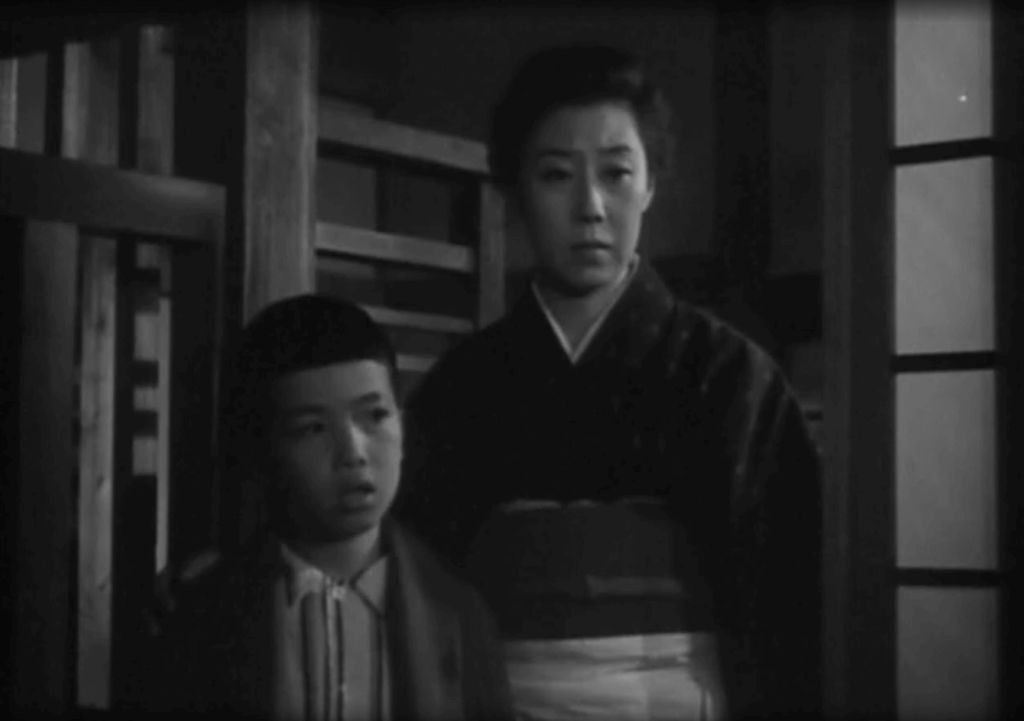
Then there is Heita’s mother, who desperately tries to get her husband to spend time with their son and show him love. The father carries a heavy load as a professor and seeks connection with his students. He uses his work to avoid his feelings. He does not understand how to show love and relate to his special needs child.

I found myself fully invested in each of these characters. and storylines. These are all good people trying to do what they think is right. You can understand their feelings of conflict and personal duty, especially set against the pressures of Japanese society at that time.

Part of what I find so appealing about all of Kobayashi’s films is he treats all of his characters with dignity. Three Loves is no exception. There is compassion, humanism, and the critique of social norms. We see and feel the conflict between people’s feelings and their duty. It’s inspiring and heartbreaking.

While some of the story beats might be a bit melodramatic, the acting and characters are not. Even at this stage of the game, we have Kobayashi’s wonderful naturalistic acting style, allowing his characters to subtly reflect on their feelings without being too over the top.

Be warned though, the ending of this film does falls into the “inevitable” category. I won’t spoil but you’ll see it coming.

While Three Loves might be less sweeping than many of Kobayashi’s future masterpieces, this movie is well worth your time. It’s full of a great characters and an important stepping stone in his career. A great film to watch on a lazy, weekend afternoon. I love this movie.

Where To Watch

You’ll be hard-pressed to find this film on physical media or on any streaming service. It’s a real crime that so many of Kobayashi’s films seem to have been lost to time. This movie deserves to be seen by more people and is in dire need of a restoration.

At any rate, I came upon an AMAZING website that hosts a variety of lost or hard-to-find movies. Follow the link below to watch ‘Three Loves’ right now!

I would love to hear your thoughts on this one, if you want to leave any in the comments.

8 responses to “Why I Love Masaki Kobayashi’s ‘Three Loves’ (1954)”

  1. Happy to see that I am not the only one, who really worships the genius of Masaki Kobayashi. I might be a heretic in saying the following, but I rate him even higher than Ozu and Kurosawa. Both made great movies, but Kobayashi directed HARAKIRI, THE HUMAN CONDITION, SAMURAI REBELLION and THE INHERITANCE. The first 2 have to be on every “best 10 Japanese movies ever made”-list, which wants to be taken serious (if they are not, forget that list).

    And those 4 are just the peak. They guy made only 23 movies, of which I have seen around 15, and each and every one of them left an impression. Many Ozu movies do, many Kurosawa do, but not each and every one (they also made a lot more than Kobayashi). Kobayashi should be much better known, imho, and I am happy to see someone sharing my opinion and keeping his legacy alive.

    Sorry, can´t join on facebook, since I am not into social media, not my cup of tea.

    Liked by 1 person

    1. I agree with everything you just said! Last year sometime, I started a deep dive into Akira Kurosawa’s filmography. Sure, I’d some of his big films but I had no idea there were so many I’d never even heard of. Anyway, I was blown away by everything and decided to read his autobiography (which is amazing) and every filmmaker name Kurosawa mentioned in that book I’d stop and take a look at their films. That road led me to Masaki Kobayashi. I will fully admit coming from Kurosawa my expectations were wrong going into Harakiri and didn’t really click with it on my first watch. Oddly enough, it was Sincere Heart that hooked me on his work. For me, it was an easier way to digest the themes and character types that Kobayashi was going to present over the course of his career. I still have several of his big films left to watch for the first time and will fully admit I’m letting time pass between film watches for him. Like Kurosawa, I think I’ll be kinda sad when I’ve seen every film and there is nothing new to watch for the first time. I’m funny like that. I also couldn’t believe how out of print and hard to find so many of his films are! It’s a crime. I wish I had the funds and means to get them all remastered and put out on blu-ray. All this to say, I agree with you. I love Ozu and Kurosawa but there is something different about Kobayashi’s work that stands apart. I really appreciate your comment and giving me the opportunity to ramble on about how much I appreciate Kobayashi’s films. I totally understand about not being on social media. If I didn’t need to be there for work or family I wouldn’t.

      Like

      1. Thanx for your great comment! Same feelings here: I´ve also seen many movies of these 3 “giants” of Japanese cinema (plus lemme add Kenji Mizoguchi as forth “giant”, whose movies I absolutely recommend) and it´s hard to say whom I appreciate the most, but over the last 5 or so years I´ve come to the conclusion that for me it´s indeed Kobayashi, because …

        >>> I’m letting time pass between film watches for him.<<<

        Same here! … because after the first 2 or 3 I realized that I am actually “exhausted” after each of them: mentally exhausted. That does not happen too often, because I have seen 1000´s of movies over 4 1/2 decades (300/year is a rather safe guess) and there is rarely something new or so “demanding” in any movie, that makes me feel that way. But there are still movies – thanx God! – after having watched them I need time to let them sink. They stay with me for days, weeks and sometimes even months (and I remember those “forever”). I cheerish such experiences, because they are rare. And that happened with HARAKIRI, THE SAMOURAI REBELLION, all parts of HUMAN CONDITION (especially the ending shattered me) and also THE INHERITANCE.

        I´d say that Kobayashi is the most “humanist”/emphatic of those four directors (Mizoguchi is 2nd, Ozu is more an “observer” of human relations, like a scientist, and Kurosawa is all of that, but in smaller doses, because he puts a premium on telling a bolder story, more “action-oriented”), because he manages to make the viewer really FEEL the sentiments his characters go through. One actually – at least me – relives there experiences when watching the story unfold. THAT is what exhausts me.

        And that is why I also have to let time pass before watching the next one.

        When I see a good movie by most other directors (name anyone: Peckinpah, Siegel, Boettcher, Eastwood, many many more) I say to myself “oh, that was a great one” and go on watching the next one he did. Usually until I have seen 3, 4 good ones, then I change the subject/actor/director (to maybe come back later), but with Kobayashi (and Mizoguchi and Larisa Shepitko, whose life was tragically cut so short, sigh, and a few other Russian directors) I always need more than just a few days (usually a week or longer) to have really coped with the last one I saw.

        One can watch mindless action-shit for hours and days without feeling anything (and I got that long behind me, that utter waste of time), but movies, that tell important stories about “the human condition” are movies, that can´t be dismissed and won´t be forgotten easily and Japanese (and some Russian) direcors were masters in this field.

        Just my few cents. 🙂

        Like

      2. Man, you and I are on the same page across the board except you’re a bit further along with what you’ve watched. I absolutely agree with your analysis of each of these directors. I’ve only seen Kenji Mizoguchi’s Sansho The Bailiff but have his other films in my queue. That movie was incredible and need to post about it but oddly enough like you said, after watching a movie like that I had to take a break. Sit with it for a while. As much as I want to dive into more works like it right away I usually have to watch some fluff before going back to the good stuff, if that makes sense. Honestly it’s all fluff compared to the films by filmmakers like these. Before I started this blog I was really into Russian directors for a stretch. You can only watch so many Andrei Tarkovsky or Andrey Zvyagintsev films in a row before you gotta decompress. I think Loveless was the straw that broke the camel’s back and I had to walk away for a bit but will come back to the Russian directors. Like the French and Japanese masters, they just touch upon some of the real childhood wounds to well sometimes. And I got here the same way as you after years of digesting ONLY mainstream action shit for years someone showed me Seven Samurai and it broke my cinematic world open.

        Like

  2. PS: rarefilmm is indeed a trasure drove, seen dozens of great ones there!!

    Like

    1. There really are! Internet Archive is pretty sweet too.

      Liked by 1 person

      1. Yes, the “Internet Archive” is superb!! Found many (French!) movies there (with engl. sub´s, because though I had French in school for 6 years, I don´t understand them talking fast), which I didn´t find anywhere else.

        I gotta add that I love “noir” (and some “neo noir”) for the same reasons I love Jap and Russian cinema: because noir-movies tell stories about human relations (greed, violence, etc) in extreme situations and French cinema brought us some of the absolut darkest noir´s imagineable (I can let you know a few titles). I found some of those in the “Internet Archive”. Great site and huuuuuugeeee. One life is by far not enough to find all the nuggets … lol

        Like

      2. Yeah I just recently found out the Internet Archive had some many hard to find foreign films with English subtitles. There is no shortage of films for me to see! I love me some French films. lol Deep and personal and fearless. They tend to hit on the same levels as Russian and Japanese for me but at some other level. All of these types of film give me the one thing I crave which is the honest truth you don’t find in most movie making. Not exactly something you can sit down to watch with everyone but great for personal growth and opening the mind.

        Like

Leave a comment

Trending