

In the opening moments of Director Masaki Kobayashi’s film Three Loves, a narrator says, “In all ages and all places, only people who live sincerely and seriously will be granted supreme joy. I wish to give praise and sing a song of joy. To the joy brought by the bitterness and sadness of life.”
We then see a young boy, Heita, running and jumping happily through the tranquil countryside, following a bird back to its nest. A church-like choir sings Hallelujah in the background, elevating this beautiful moment. It all feels like pure joy. The freedom of the outdoors and being a kid. Life has its moments.

While Three Loves is not as well-known as his many of his later films, like Harakiri or The Human Condition, this early directorial effort by Kobayashi stands as a further testament to Kobayashi’s masterful writing and directing skills.
The film follows Heita, a sensitive and gifted boy living in a mountain village who is alienated by the locals due to his uniqueness. He forms connections with a new boy who works at a brewery, the village pastor named Yasugi, and his teacher Michiko.

The story weaves together three separate narratives about love; each character Heita connects with has their own personal struggles, adding complex layers to Heita’s life as he tries to figure out his place in the world.
As the title suggests, this film is an exploration of love. Maternal love. Romantic love. Altruistic love. Love can be a source of joy and happiness but also a filled with difficulty, sacrifice, and pain. Each of the stories running through this film depicts love as a source of strength and suffering.
The pastor who feels he must abandon his family to get closer to God.
The starving artist husband who feels he is unworthy to take care of his sick wife.
The mother who can’t afford to feed her son and takes him to live with another family who can feed and school him.
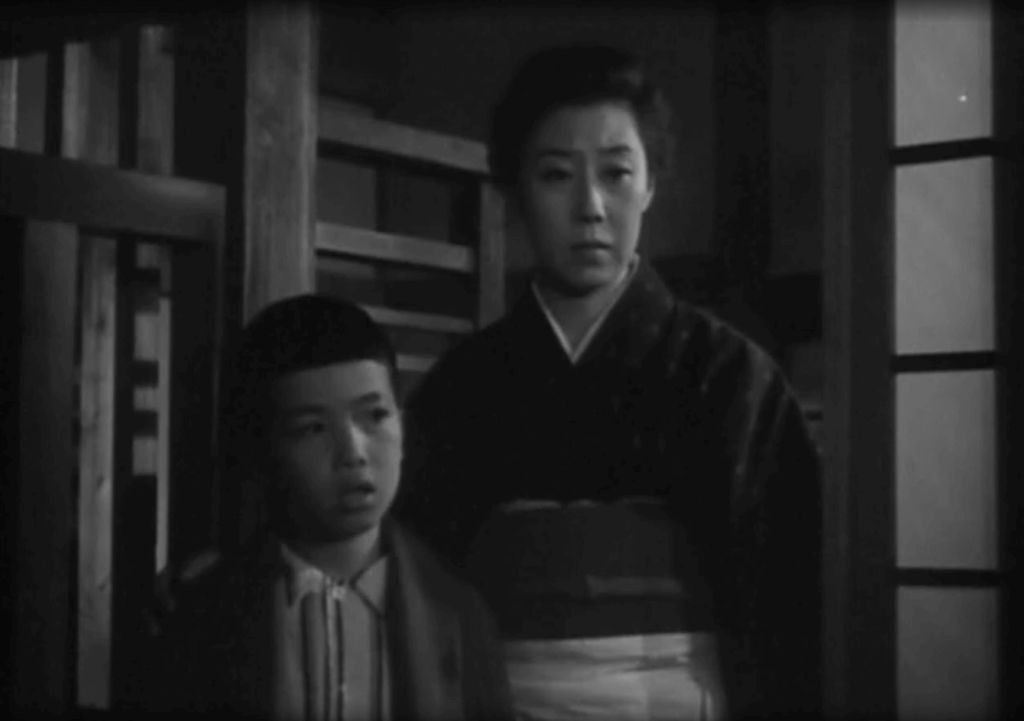
Then there is Heita’s mother, who desperately tries to get her husband to spend time with their son and show him love. The father carries a heavy load as a professor and seeks connection with his students. He uses his work to avoid his feelings. He does not understand how to show love and relate to his special needs child.
I found myself fully invested in each of these characters. and storylines. These are all good people trying to do what they think is right. You can understand their feelings of conflict and personal duty, especially set against the pressures of Japanese society at that time.

Part of what I find so appealing about all of Kobayashi’s films is he treats all of his characters with dignity. Three Loves is no exception. There is compassion, humanism, and the critique of social norms. We see and feel the conflict between people’s feelings and their duty. It’s inspiring and heartbreaking.
While some of the story beats might be a bit melodramatic, the acting and characters are not. Even at this stage of the game, we have Kobayashi’s wonderful naturalistic acting style, allowing his characters to subtly reflect on their feelings without being too over the top.

Be warned though, the ending of this film does falls into the “inevitable” category. I won’t spoil but you’ll see it coming.
While Three Loves might be less sweeping than many of Kobayashi’s future masterpieces, this movie is well worth your time. It’s full of a great characters and an important stepping stone in his career. A great film to watch on a lazy, weekend afternoon. I love this movie.
Where To Watch
You’ll be hard-pressed to find this film on physical media or on any streaming service. It’s a real crime that so many of Kobayashi’s films seem to have been lost to time. This movie deserves to be seen by more people and is in dire need of a restoration.
At any rate, I came upon an AMAZING website that hosts a variety of lost or hard-to-find movies. Follow the link below to watch ‘Three Loves’ right now!
I would love to hear your thoughts on this one, if you want to leave any in the comments.





 Cinematic Point Of View
Leave a reply to wmjahn Cancel reply