
The IMDB description Masaki Kobayashi’s film Beautiful Days reads “…a romantic drama concerning a family of florists.” I feel like that’s selling this movie short by a country mile.
Beautiful Days is a much richer and more thoughtful exploration of Japanese post-war life than it gets credit for and story full of themes that still resonate today. The story follows a group of middle school friends, now young adults, and a grandmother, as they try to figure out their lives, quietly exploring themes of isolation, beauty, and the emotional scars left by war.

The Characters
I love every one of the many characters in Beautiful Days. Each one is written in a way that they feel full and complete. Even the supporting characters that enter the lives of the main group feel fully fleshed out.


Dr. Imanishi – A young, jaded doctor working within a flawed medical system who keeps quitting out of stubborn pride. He is in love with a young woman named Sakurako. The state of the world has left him feeling so depressed that feels he isn’t good for anyone or anything.
Hakamada – A young man who had dreams of being a pilot. Broken by the war and left poor, he is forced to take a job in a steel factory to support his family now living as squatters on a shack. He carries a grudge against his friends that don’t appreciate what they have.
Nakao – A young man who went to school to be a lawyer, but returned home from the war unable to find employment. Pessimistic and distant, he makes ends meet as a struggling musician and builds a wall around his feelings. He struggles to let himself feel connected to others and anything in the world.
Sakurako – A young woman works at Grandma Tokioka’s flower shop. She lost her parents to an explosion during the war. She loves Dr. imanishi but can’t seem to get him to snap out of his depression.
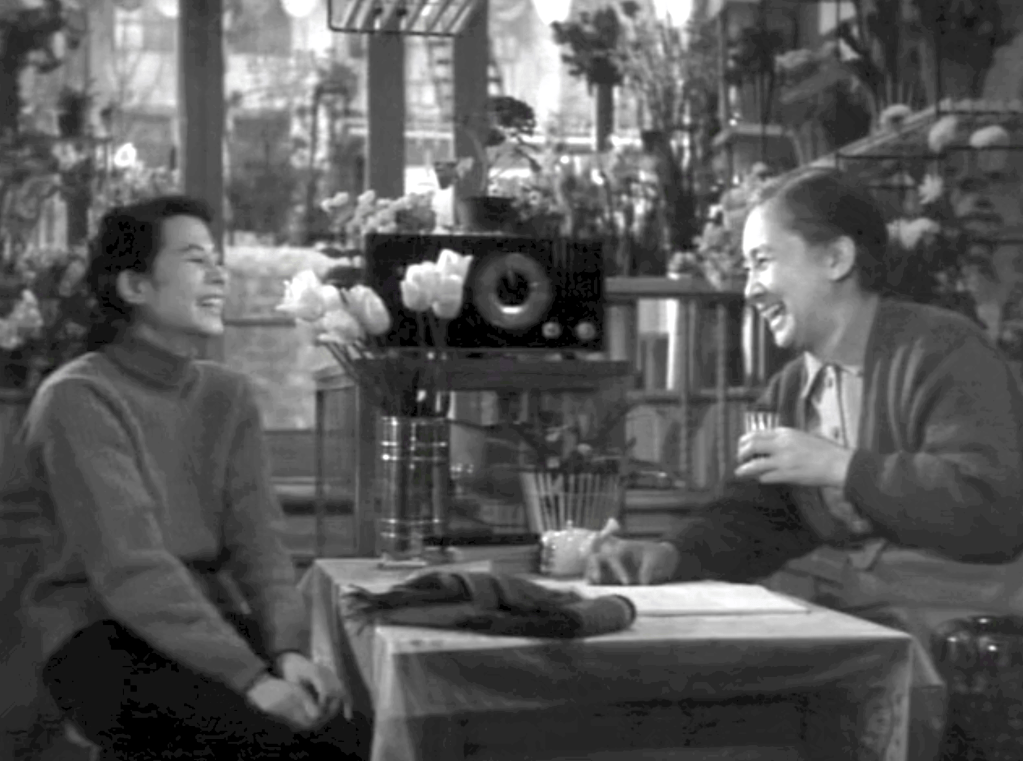
Grandma Tokioka – A king, elderly woman who, having lost her husband and two sons to war, runs the family flower shop, with her grand daughter Sakurako’s help. She attempts to provide advice to the younger generation. She is literally planting seeds (flowers) for tomorrow and strikes up a friendship with an kind, older gentleman.
Mr. Shigaki – A wise, retired CEO who, having turned his company over to his boys now looks to help out wherever he can, find a wife for his son, and figure out his own place in the world.
Yumi – A young, divorced mother who has little choice but to work as a dancer at a club to support her child and sick mother. She has a complicated relationship with Nakao.
The Stories
There is a lot going on in this movie. You really have to pay attention.
There are no throwaway moments. You’ll learn something from the smallest gesture, a gentle line of dialogue, or a quiet interaction on a park bench. It’s really impressive. You’ll notice something new with every viewing.
There is a brief moment in the flower shop between Sakurako and Dr. Imanishi. He breaks the bud off a flower and pretends it came off on its own. Sakurako laughingly tells him she saw him do it on purpose, to which he quickly admits he had lied. She laughs it off and tells him she knows. It’s a small moment, but on the second viewing, I realized this was her way of further telling him that she accepts him as he is right now.

This attention to detail is always where Kobayashi shines for me. His ability to create films with rich, complex characters who struggle under the weight of social norms.
In another scene, Nakao and Yumi are having a conversation about their relationship. Yumi is dedicated to providing care for her ill mother, yet is looked down on for having “failed” at a previous marriage. Nakao is the product of an affair, a child of a mistress. Growing up he was bullied endlessly. Yumi’s mother does not approve of their relationship so Nakao reinforces his emotional distance by acting as if he doesn’t care about Yumi. “I’m just a playboy. I use women,” he explains. It’s a front he puts up to everyone he knows and Yumi knows it.

Kobayashi’s swift direction keeps the focus on the inner monologue and the complexity of a life disrupted by war. Scenes develop through mostly quiet, intimate ordinary moments. A walk by the river. A conversation on a bridge. A stroll down the street or in a restaurant. Ordinary locations.
Speaking of the locations, they are amazing! You get an excellent, up-close look at a rebuilding Japan in the 1950s. On my second viewing, I took notice of the intricate camera work out in the real world. I wish there were a “behind-the-scenes” of productions like this, as it would be something to see what sort of crew helped bring this film to life. A city undergoing transformation is the perfect backdrop for this thoughtful, melancholy tale.
The Message
I love the message of Beautiful Days; life can be unpredictable and sometimes lonely, but there is always beauty in life’s simple moments. This is a solid message, especially if you’re battling depression, as the majority of these characters are. It’s a message that seems more important than ever these days.

Grandma Tokioka remarks in one conversation, “Life is unpredictable.” She’s been through it all. Her life has been a constant, unexpected change. She is a widow. Her children both died in the war. She even runs a flower store, which perfectly symbolizes temporary beauty.
There is a moment where she explains to Mr. Shigaki that one of her favorite things is to admire how the bricks on the street shine in the sunlight after it rains. This observation stirs something within Mr. Shigaki, who has been feeling lost and out of place since retiring. He can’t wait to see what sees. Grandma Tokioka is awesome. She is the message in action.
Life is short. Life can be hard. Life takes work. Life is beautiful. Don’t give up!
I would consider Beautiful Days an early masterpiece. Kobayashi keeps the story moving and scenes clip along but never feels rushed. The script gives you time to contemplate all the interactions and dialogue.
This is also the film where Masaki Kobayashi started working with screenwriter Zenzo Matsuyama, who would later help him adapt The Human Condition into a film. This feels like an important step toward what will be achieved down the road.
I can’t recommend this film enough. Give it a watch and then watch it again! I found it available to stream free on Internet Archive or it’s also on Criterion Channel.


 Cinematic Point Of View
Leave a comment